
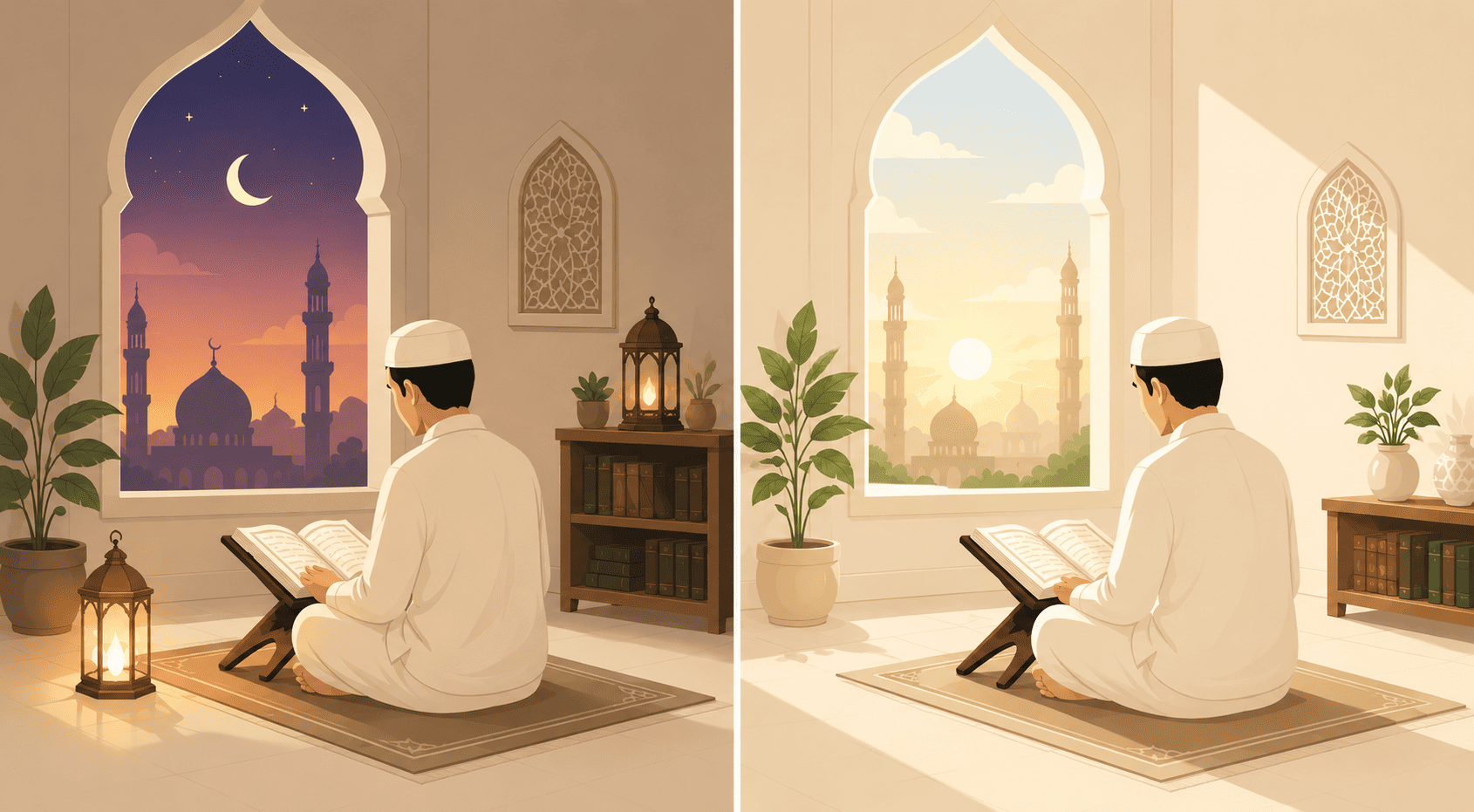
Every day is a gift from Allah — and how you begin and end it matters more than you might think. Reciting the morning and evening adhkar established by the Prophet Muhammad (ﷺ), is a simple yet powerful way to strengthen your relationship with Allah. These are not optional extras for the spiritually advanced; they are a Sunnah practice that every Muslim can and should adopt. This article covers what these adhkar are, when to read them, why they matter, and the complete collection to get you started.
What Are the Morning and Evening Adhkar?
The morning and evening adhkar — known in Arabic as Adhkar al-Sabah wal-Masa — are a set of authenticated duas and remembrances drawn entirely from the Quran and the Sunnah of the Prophet (ﷺ). They cover protection from evil, gratitude to Allah, declarations of tawheed (oneness of Allah), seeking forgiveness, and asking for wellbeing in this life and the next. A Muslim who recites the morning and evening adhkar consistently places themselves under Allah’s direct protection for the entire day and night.
What are the Best Timings for Morning and Evening Adhkar?
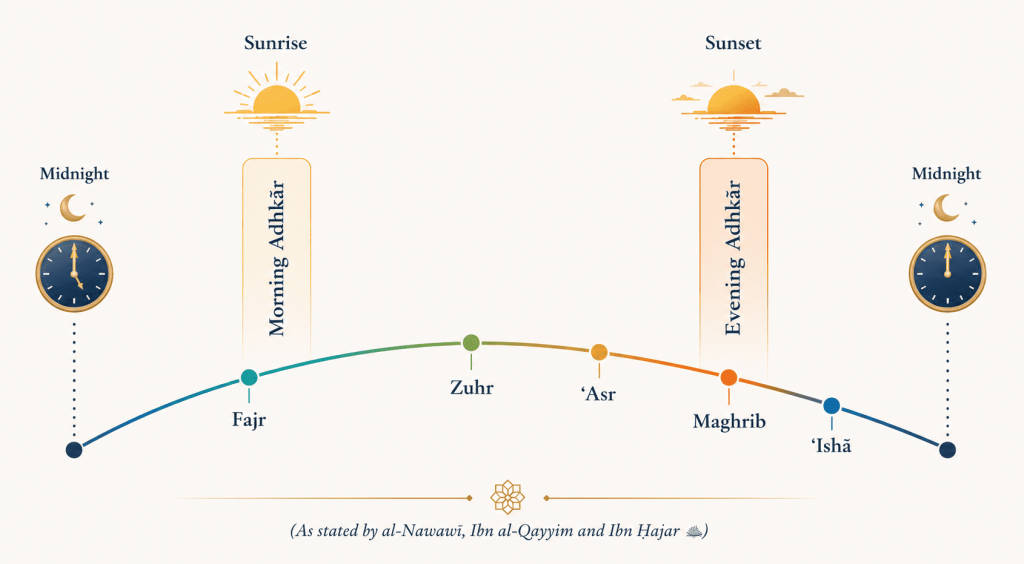
Knowing the right time makes all the difference in maximising the reward of the adhkar.
(i.) Morning Adhkar — Best Time – The optimal time for morning adhkar is after Fajr prayer until sunrise. This is a blessed window — the Prophet (ﷺ) himself used to sit in his prayer place after Fajr, engaged in dhikr until the sun had fully risen.
(ii.) Evening Adhkar — Best Time – The optimal time for evening adhkar is after Asr prayer until Maghrib (sunset). The word masa (evening) in the Quranic context refers to the late afternoon period — the mirror image of the morning window. Some scholars extend the permissible period to the first third of the night.
When Should You Recite Them?
The morning and evening adhkar are among the most powerful daily habits a Muslim can build. Here is why you should never miss them:
(i.) The adhkar form a spiritual shield against the evil eye, black magic, envy, and the whispers of Shaytan.
(ii.) Many adhkar carry direct promises of forgiveness.
(iii.) Consistent dhikr calms anxiety and replaces overthinking with a deep, grounded peace.
(iv.) Starting and ending your day with Allah’s remembrance builds true tawakkul — giving you the clarity, strength, and confidence to face whatever comes.
What are Some Powerful Morning and Evening Adhkar?
The adhkar are not just words to read quickly; they are a daily spiritual practice that shapes the heart. Here are some of the powerful morning and evening adhkar that every Muslim should recite daily.
(A.) Morning Adhkar: A Blessed Beginning to Your Day
(i.) Dua for Wellbeing in Body, Hearing, and Sight
اللَّهُمَّ عَافِني في بَدَني، اللَّهُمَّ عَافِني في سَمْعي، اللَّهُمَّ عَافِني في بَصَري
Transliteration – Allahumma ‘afini fi badani, Allahumma ‘afini fi sam’i, Allahumma ‘afini fi basari, la ilaha illa Anta.
Translation: “O Allah, grant me wellbeing in my body. O Allah, grant me wellbeing in my hearing. O Allah, grant me wellbeing in my sight. There is no deity except You.”
(Recite 3 times | Abu Dawud)
(ii.) Morning Declaration of Sovereignty
أَصْبَحْنَا وَأَصْبَحَ الْمُلْكُ لِلّهِ، وَالْحَمْدُ لِلّهِ، لا إِلهَ إِلّا اللّهُ وَحْدَهُ لا شَريكَ لَهُ
Transliteration – Asbahna wa asbahal-mulku lillah, wal-hamdulillah, la ilaha illallahu wahdahu la sharika lah, lahul-mulku wa lahul-hamd, wa Huwa ‘ala kulli shay’in Qadir.
Translation – We have entered a new morning and with it all dominion belongs to Allah. Praise is to Allah. None has the right to be worshipped except Allah alone, with no partner. To Him belongs the dominion and to Him is the praise, and He is capable of all things.”
(Recite 1 time | Muslim)
(iii.) Sayyidul Istighfar — Master Supplication for Forgiveness
اللَّهُمَّ أَنْتَ رَبّي لا إِلهَ إِلّا أَنْتَ، خَلَقْتَني وَأَنَا عَبْدُكَ
Transliteration – Allahumma Anta Rabbi, la ilaha illa Anta, khalaqtani wa ana ‘abduka, wa ana ‘ala ‘ahdika wa wa’dika mastata’tu, a’udhu bika min sharri ma sana’tu, abu’u laka bi ni’matika ‘alayya, wa abu’u bi dhanbi faghfir li, fa innahu la yaghfirudh-dhunuba illa Anta.
Translation: “O Allah, You are my Lord. There is no deity except You. You created me and I am Your servant. I uphold Your covenant and promise as best I can. I seek refuge in You from the evil I have done. I acknowledge Your blessings upon me and I confess my sins. Forgive me, for none forgives sins but You.”
(Recite 1 time — Whoever says it in the morning with conviction and dies that day enters Paradise | Al-Bukhari)
(B.) Evening Adhkar for Protection and Peace
(i.) Evening Supplication of Reliance on Allah
اللَّهُمَّ بِكَ أَمْسَيْنَا وَبِكَ أَصْبَحْنَا، وَبِكَ نَحْيَا وَبِكَ نَمُوتُ، وَإِلَيْكَ الْمَصيرُ
Transliteration – Allahumma bika amsayna wa bika asbahna, wa bika nahya wa bika namutu, wa ilaykal-masir.
Translation: “O Allah, by You we have entered the evening and by You we enter the morning. By You we live and by You we die, and to You is the final return.”
(Recite 1 time | At-Tirmidhi)
(ii.) Seeking Refuge from Disbelief and Poverty
اللَّهُمَّ إِنّي أَعُوذُ بِكَ مِنَ الْكُفْرِ وَالْفَقْرِ
Transliteration – Allahumma inni a’udhu bika minal-kufri wal-faqr, wa a’udhu bika min ‘adhabil-qabr, la ilaha illa Anta.
Translation: “O Allah, I seek refuge in You from disbelief and poverty, and I seek refuge in You from the punishment of the grave. There is no deity except You.”
(Recite 3 times — Comprehensive protection for the evening | Abu Dawud)
(C.) Adhkar for Both Morning and Evening
(i.) SubhanAllah wa bihamdihi
سُبْحـانَ اللهِ وَبِحَمْـدِهِ
Transliteration – Subhaan Allahi wa bi hamdihi.
Translation: “Glory and praise be to Allah.”
(Recite 100 times — Sins forgiven even if like the foam of the sea | Al-Bukhari, Muslim)
(ii.) Dua for Complete Reliance on Allah
يَا حَيُّ يَا قَيُّومُ بِرَحْمَتِكَ أَسْتَغِيثُ أَصْلِحْ لِي شَأْنِي كُلَّهُ وَلَا تَكِلْنِي إِلَى نَفْسِي طَرْفَةَ عَيْنٍ
Transliteration – Yaa Hayyu yaa Qayyoom, bi rahmathika asta’eethu, aslih li sha’ni kullahu, wa laa takilni ilaa nafsees tarfata ‘ayn.
Translation: “O Ever-Living, O Eternal One, by Your mercy I seek help; rectify all my affairs and do not leave me in charge of my affairs even for the blink of an eye.”
(iii.) Refuge in Allah’s Perfect Words
اَعـوذُبِكَلِمـاتِ اللّهِ التّـامّـاتِ مِنْ شَـرِّ ما خَلَـق
Transliteration – Aoodhu bi kalimaat illaah it-taammaati min sharri ma khalaq.
Translation: “I seek refuge in the perfect words of Allah from the evil of that which He has created.”
(Recite 3 times — Nothing will harm the one who says it | Muslim)
FAQs
(i.) How long does it take to complete the morning and evening adhkar?
The full collection takes approximately 10–15 minutes when recited with focus. Beginners can start with the essentials — Ayatul Kursi, the three Quls, and Sayyidul Istighfar — and gradually build up.
(ii.) Do the morning and evening adhkar really protect against the evil eye and black magic?
Yes — this is authentically established in the Sunnah. The Prophet (ﷺ) promised that whoever recites Ayatul Kursi in the morning will be protected until evening. Consistent recitation of the adhkar forms a daily spiritual shield around the believer.
(iii.) Is there a specific order to follow when reciting the adhkar?
There is no strict required order, though following the sequence established by scholars is preferable. What matters most is that you recite them with sincerity, understanding, and consistency — the order is secondary to the act of remembrance itself.
Conclusion
The morning and evening adhkar are one of the greatest gifts the Prophet (ﷺ) left for his ummah — a daily practice that takes minutes yet carries rewards that last into eternity. Whether you are seeking protection, forgiveness, peace of heart, or simply a stronger connection with Allah, the adhkar routines provide all of this and more. Start with even a few of these remembrances each day and build from there. The believer who guards their morning and evening adhkar walks through life surrounded by the mercy, protection, and barakah of Allah — and that is the greatest provision anyone can carry.