
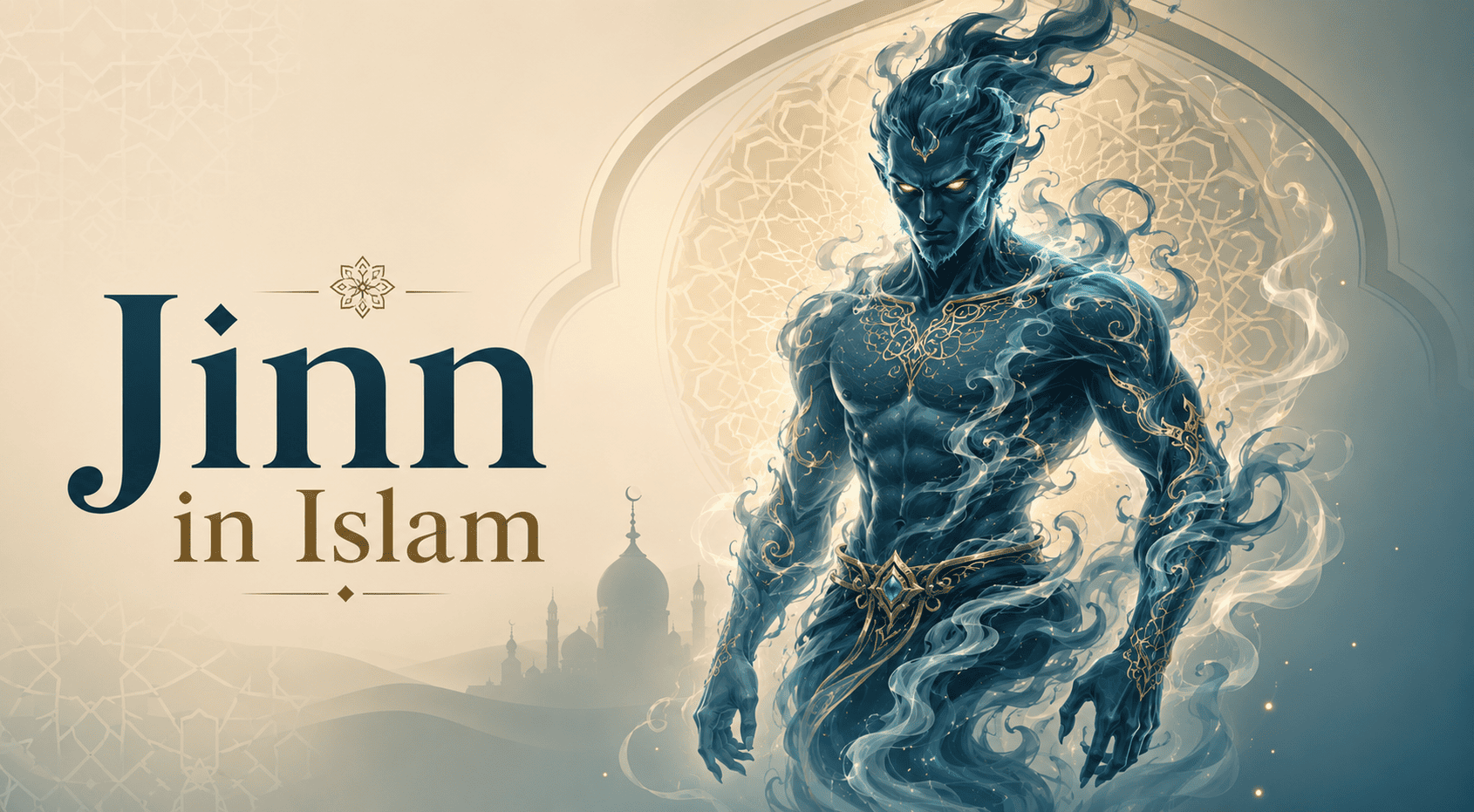
Jinn in Islam are one of the most fascinating and widely discussed subjects in Islamic theology. Unlike angels or humans, jinn occupy a unique place in Allah’s creation — invisible to the naked eye, yet very much real and acknowledged throughout the Quran and Sunnah. Many Muslims are curious about their nature, abilities, and how to protect themselves from their harm. This article offers a comprehensive, authentic Islamic perspective on jinn — covering their creation, types, characteristics, and the protections Allah has provided for believers.
What is Jinn in Islam?
The word “jinn” (جِنّ) is derived from the Arabic root janna, meaning to hide or conceal — referring to their invisible nature. In Islam, jinn are not mythical creatures or products of folklore; they are a confirmed reality of the unseen world (al-ghayb). Like humans, they are accountable to Allah, obligated to follow his commands, and will be judged on the Day of Resurrection. They are mentioned in the Quran over 29 times and have an entire surah — Surah Al-Jinn — dedicated to them.
Quran on Jinn: Understanding the Creation of Jinn in Islam

The Quran on jinn is explicit about their origin. Allah says in Surah Ar-Rahman (55:15): “And He created jinn from a smokeless flame of fire.” This is further supported in Surah Al-Hijr (15:27), where Allah states they were created before humanity. While humans were fashioned from clay and angels from light, jinn were formed from a fierce, scorching fire — a creation that reflects their nature of concealment, swiftness, and intensity.
What are the Characteristics and Abilities of Jinn?
To better understand the meaning of jinn in Islam, it is important to explore their unique characteristics and abilities as described in the Quran and Sunnah. According to Quran, and Sunnah they are capable of:
(i.) Invisibility – Jinn exist in a dimension parallel to ours and are generally invisible to humans. Allah has veiled them from ordinary sight, though they can see us.
(ii.) Shape-shifting – Jinn can take on various forms, including the appearance of animals (particularly black dogs and cats, as referenced in hadith) and even human forms.
(iii.) Speed and Movement – Jinn can travel vast distances at extraordinary speed.
(iv.) Free Will and Accountability – Like humans, jinn possess complete free will. They choose their faith, their actions, and their path — and will be held fully accountable for them before Allah on the Day of Judgment.
What Are the Different Types of Jinn in Islam?

Based on references from the Quran and authentic hadith, scholars have described the following categories of jinn according to their characteristics, behaviors, and abilities –
(i.) Muslim Jinn (Mu’min) – These are jinn who accepted Islam — as described in Surah Al-Jinn (72:1-2), a group of jinn heard the Quran being recited by the Prophet (ﷺ) and embraced the faith.
(ii.) Kafir Jinn (Disbelieving) – Jinn who reject Allah and Islam. These are the dangerous ones who align with Shaytan and seek to misguide, harm, or possess humans.
(iii.) Shaytan (Iblis and his followers) – Iblis was a jinn — not an angel — who refused to bow to Adam out of arrogance. He and his offspring became the Shayateen, the most malicious category of jinn, dedicated to leading humanity astray.
(iv.) Ifrit – Mentioned in the Quran (27:39), the ‘Ifrit is described as a powerful and cunning type of jinn. In Islamic tradition, they are known for their great strength and are considered among the more formidable jinn.
(v.) Marid – Marid are considered among the most powerful of all jinn.
How to Protect Yourself from Evil Jinn?

Allah has provided believers with complete protection through remembrance and Quranic recitation. Here are the most authentic and powerful shields:
(i.) Ayatul Kursi (2:255) – The Prophet (ﷺ) said that reciting Ayatul Kursi before sleeping ensures an angel guards you all night and Shaytan cannot approach you. It is the greatest verse in the Quran and the most powerful protection against evil jinn.
(ii.) Surah Al-Falaq (113) – This surah asks Allah for protection from the evil of all creation — including the harm of those who blow on knots (a reference to black magic) and the evil of envy. It directly addresses threats from the unseen world.
(iii.) Surah An-Nas (114) – Paired with Al-Falaq, Surah An-Nas specifically seeks refuge from the whispering of Shaytan and jinn into the hearts of men. Reciting both surahs (Al-Mu’awwidhatayn) morning and evening is a Sunnah of the Prophet (ﷺ).
(iv.) Morning and Evening Adhkar – The daily adhkar — particularly “A’udhu bikalimatillahit-tammati min sharri ma khalaq” (I seek refuge in the perfect words of Allah from the evil of what He has created) — recited three times each evening provides comprehensive protection.
FAQs
(i.) Where Do Jinn Live?
Jinn are said to inhabit desolate places — deserts, ruins, forests, graveyards, and dark, abandoned spaces. They also dwell in places of filth, which is why Islamic etiquette includes saying Bismillah before entering the bathroom.
(ii.) Can Jinn Interact With Humans?
Yes — but within limits set by Allah. Evil jinn can whisper, disturb sleep, cause fear, and in rare cases of possession, affect the body — known as mass (لمس).
(iii.) Can Jinn Be Seen?
In their natural state, jinn are invisible to humans. However, Islamic scholars confirm they can choose to appear in physical forms — most commonly as animals or shadowy figures.
Conclusion
Jinn in Islam are a confirmed, Quranic reality — not superstition, not mythology, but a living part of Allah’s creation that believers must acknowledge and understand. From their fiery creation to their diverse types, abilities, and the misguidance of Shaytan among them, Islam provides a complete and balanced framework for understanding the unseen world. More importantly, Islam and jinn coexist within a divine order where Allah’s protection — through the Quran, adhkar, and sincere faith — is always greater than any harm jinn can cause.